
Why I Train Hips for Core and Pelvic Floor Support Postpartum
Postpartum Core and Pelvic Floor Recovery: Why Hip Strength Matters
If you’re postpartum and trying to rebuild strength, you’ve probably heard the same advice on repeat.
“Do your Kegels.”
”Close the gap.”
And while those things are not useless, they are incomplete movements which won’t help you get closer to your goal of training with freedom.
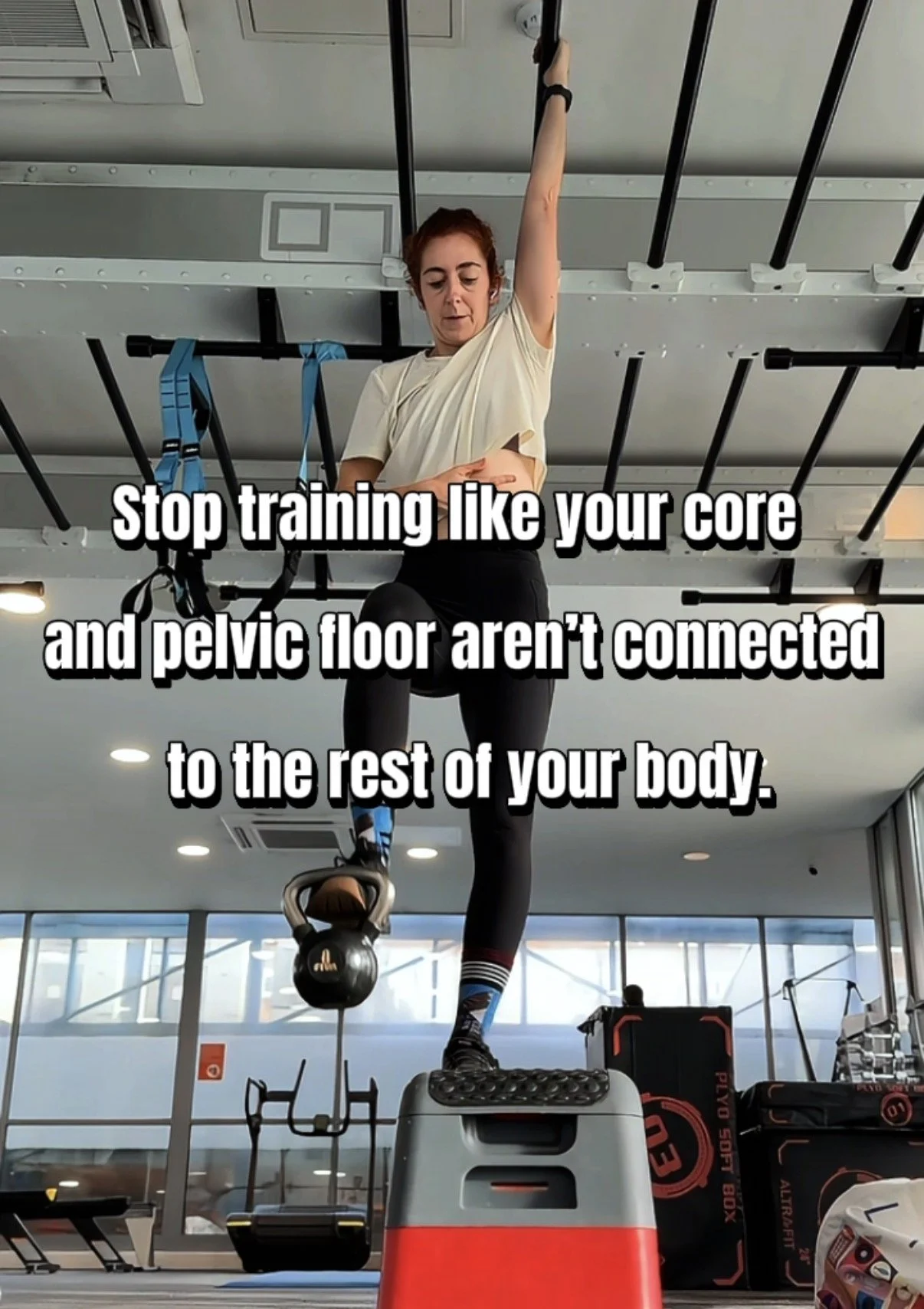
Your core and pelvic floor are not solo acts, they’re part of a full and complex pressure system. And if we ignore the rest of that system (hips, back, serrates anterior, thoracic mobility), we miss the bigger picture.
The Bigger Picture Most Postpartum Advice Skips
Your body manages pressure through a coordinated team of muscles:
The diaphragm at the top.
The abdominal wall around the sides.
The deep spinal stabilisers at the back.
The pelvic floor at the bottom.
When that system works together, load is shared and that helps support core and pelvic floor health.
When it doesn’t, pressure has to go somewhere. And often, it goes down or out … AKA towards the pelvic floor or out against the abdominal wall.
That’s when women describe:
Heaviness.
Dragging.
Leakage.
Doming through the abdomen.
A sense of instability under load.
That’s not just “weak pelvic floor” or “core dysfunction”. That’s a system struggling to manage pressure.
So Where Do the Hips Fit In?
Your hips are a major contributor to pelvic control and spinal stability.
The deep hip flexors, glutes and rotators all influence how your pelvis sits and how force moves through your body when you lift, run, squat or carry your child.
Research in spinal biomechanics shows that muscles like the psoas contribute to lumbar stability and trunk stiffness under load. That stiffness matters because it helps distribute force more evenly across the abdominal wall.
We also know from pelvic health research that hip muscle activation often occurs alongside pelvic floor activation. Hip strengthening, when combined with pelvic floor work, has been shown to improve urinary incontinence outcomes.
That tells us something important, the pelvic floor does not work in isolation, it responds to the demands placed on the whole system.
In my coaching experience
I am training women everyday and in my experience as a Specialist Coach, when hips are undertrained or poorly coordinated postpartum, I often see:
More bracing.
More breath holding.
More gripping through the pelvic floor.
More symptom flares when load increases.
Not because the pelvic floor is “failing”, but because it’s being asked to do too much on its own. Weak hips do not directly cause prolapse or diastasis, but they can increase the load demand placed on tissues that are already recovering. Which instead of supporting the core and pelvic floor, it can actually lead to a flare of symptoms.
Why I Don’t Just Prescribe Kegels
Kegels have their place. But only training your pelvic floor is like expecting one player to win the whole match. If the rest of the team isn’t contributing, that one muscle ends up overloaded, exhausted, tight and likely to fail.
Instead, I prioritise:
Single leg strength work.
Controlled hip flexion.
Glute strength.
Breathing that matches effort.
Gradual exposure to real world load.
Because strong, coordinated hips support:
Better pelvic positioning.
Better load transfer.
Better pressure management.
Shared stability across the whole system.
And when load is shared, symptoms are less likely to flare and…. it might be possible to test the edges of what your training capacity is, and hopefully, expand on that.
About “The Gap”
It is really natural to want to close your diastasis Recti gap but it is also important to note that gap and function are not the same thing. Obsessing over the gap in diastasis recti misses something important. Research shows that separation width alone is not strongly correlated with function. What matters more is tension, load management and how well the system handles pressure.
Closing the gap is not the same as restoring strength. What a lot of women also want is to lift, run, jump and carry their kids without fear or symptoms. That requires robustness, structure and strategy to achieve that.
The Real Goal of Postpartum Recovery
For me, postpartum recovery is not about avoiding movement, it’s about rebuilding a body that can tolerate movement.
That means zooming out.
Stop just doing Kegels.
Stop obsessing over the gap.
When your hips, core and pelvic floor work together rather than compensating for each other, recovery feels stronger, more stable and far more sustainable.
That’s the difference between symptom management and true strength. True strength gives you freedom so you can train, live and lift without unnecessary limits.
